The broader question: how can stakeholders manage the lake for all its uses, now and into the future?
This really isn’t a single homeowner’s issue. There are many uses of this public waterway. Any change in management, big or small, needs to seek out what will serve as many users as possible, now and in the future. We’ve accomplished some important changes recently: public education is rolling out, new buoys are going in, a new ordinance has established a no-excessive wake zone at 300-feet. If we all follow the rules, maybe individual homeowners won’t need buoys in front of their property.
The Hayden Lake Watershed Improvement District is committed to preserving and enhancing water quality in Hayden Lake. We will evaluate the results of these changes next year after they’ve had a chance to work. Then, we will consider what further adjustments might be needed.
In the meantime, property owners should watch for and communicate impacts – good and bad.
And all members of the community can come together in the Hayden Lake Watershed Association to advocate for their needs.
The answer to this oft-asked question is complicated.
The lake is the property of the State of Idaho, which the Idaho Department of Lands (IDL) administers. Property owners must apply for a permit for any encroachment, i.e., docks, water pipes, buoys, etc. into or on the lake. IDL will grant dock permits to individuals but will permit navigation buoys only to units of government. For example, every lakeshore homeowner has a permit for their dock, but the City of Hayden Lake holds permits for ten navigation buoys along the City’s waterfront.
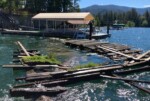
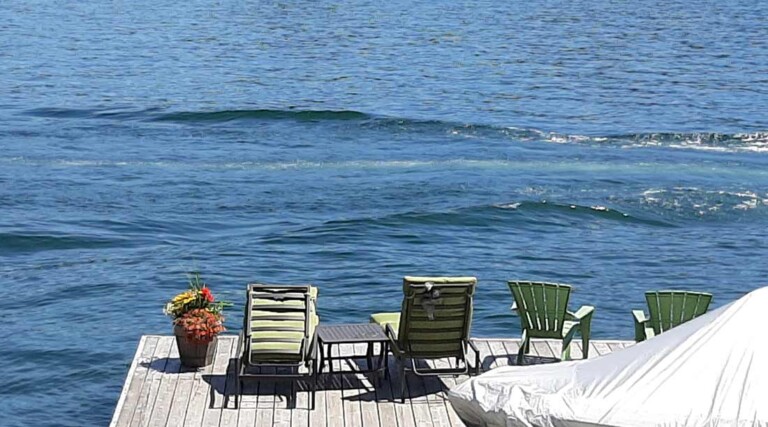
Indisputably, wakes and waves transfer the energy that they carry to any object in their path. That energy transfer can be fun! Skiers, surfers, and some boaters know this to be true. It can also damage objects like docks, boats, shorelines, and people. Managing the balance between entertainment and destruction involves regulation, education, and enforcement.
Regulation
There are both state and county rules (1) about speed, noise, and wake offset from the shoreline. One of those rules stipulates no wakes higher than four inches, and no speeds greater than five miles per hour within 200 feet of the shore or any structure or human being in the water. A new rule specifies that no excessive wakes – those caused by plowing, using ballast, or maintaining transition speed – can be produced within 300 feet of shore or other obstacles. From 300 feet to the center, the lake is open to wakes.
Education
If boaters know the rules and where to apply them, they will do their part. Such is the expectation of many who care for our waterways.
Last year, Kootenai County applied for 14 navigation buoys on Hayden Lake, to be placed per county ordinance at 200 ft from shore. The objective of this project is one of public education. The 200-ft no-wake zone exists whether there is a buoy to mark it or not. But it can be a challenge to determine one’s distance from the shore, a dock, or other obstacles. These buoys will train boaters to more accurately judge 200 ft – with or without a buoy – so they can keep their speed below five mph in that no-wake zone.
IDL permitted the buoys, and the County transferred them to the Hayden Lake Watershed Improvement District (a unit of local government). IDL placed one condition on the project: that all illegal buoys be removed first. The Sheriff’s Marine Sargent Will Klinkefus, who is very supportive of this project, helped to choose the 14 locations based on knowledge of the high-traffic areas around the lake.
The Improvement District is deploying the 14 permitted buoys this year. The County Commissioners want to see how this is going to work and to reassess the impact next year. One of our County Commissioners – Leslie Duncan – believes a light touch of government is best, so is cautious about imposing more government rules on boaters. Her initial preference was for eight buoys around the 30-plus-mile shoreline of the main lake. The additional six buoys, while not many, will allow there to be two buoys in a boater’s line-of-sight. The Improvement District will evaluate the results of the 14 buoys next year and review the need to apply for more.
Enforcement
You can achieve only so much with rules and physical delineation without enforcement. In the past, all the private buoys located at various distances from the shore frustrated the Sheriff’s enforcement of the 200-ft no-wake zone. So, admittedly, the Sheriff didn’t enforce the rule broadly. Today, to strengthen the impact of the buoy project and the new ordinance, the Sherriff’s Marine Division has committed to enforcing the 200-ft no-wake zone and the 300-ft no-excessive wake zone. They will maximize their visibility on the lake to the limit that their resources will allow. They will do all they can to educate the public with frequent stops and, when warranted, issue citations.
How CAN you get a buoy in front of your property?
Optimizing the number and position of buoys on the lake is a process that will take some time. Building a community-wide culture of care for the lake will too. In the near-term, many property owners will wish for a buoy in front of their dock. Know that the effects of excessive wakes on docks and the shoreline may get worse before they get better. The path for individual property owners runs through the Sheriff’s Marine Division, the County Commissioners, the County Parks and Waterways Department, and the Idaho Department of Lands. (2)
Be patient. Let the recent changes in regulation, education, and enforcement show their worth. Take time to listen to others. Give stakeholders leeway to work with and through their organizations to build effective solutions.
Be vigilant – not a vigilante. Observe and document when good things happen as well as bad.
Communicate. Call the Sheriff when support is needed. Share your observations with the County Parks and Waterways. Politely express your ideas to the County Commissioners. One phone call will not improve a situation; ongoing, thoughtful dialog will.
Join your voice with others in the Hayden Lake Watershed Association, your volunteer citizen’s advocacy group. They have been a vital advocacy partner for the current buoy project. This group can help you chart a compelling course of communication with and through the lake’s stakeholders.
Because it affects water quality, minimizing shoreline erosion and damage is a priority issue for the Watershed Improvement District. We will continue to advocate for Hayden Lake water quality, erosion control, and, indirectly, boater safety.