
Through the cooperation of many stakeholders who care for the well-being of Hayden Lake, its shoreline and recreating public will be more protected from the impact of wakes.
The No-Wake-Zone Keeps Swimmers and Shorelines safe.
Kootenai County law has long sought to protect our public waters and those who recreate in them by maintaining a no-wake zone extending 200 feet from any shoreline, dock, pier, breakwater, or person in the water (1). Therefore, conscientious boaters slow down whenever they are within 200 feet of just about anything other than another boat, keeping their wakes below 4 inches high. This kind of caution helps to keep swimmers from being swamped by wakes and the ecosystems of the shoreline intact.
No-wake zones are a vital strategy for preserving lakes across the country. But when you’re out there having fun on the water, where docks jut out irregularly along the shoreline, how do you know where the zone begins?
200 feet: That’s Where the Buoys Do Their Job!
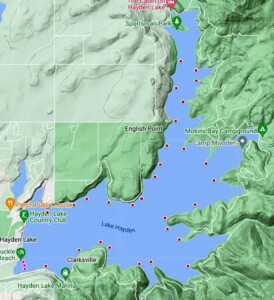
Navigation buoys, located along the most sensitive and high-trafficked portions of the lake, inscribe the invisible 200-feet edge of the no-wake zone. They mark points of land that reach out into the lake, reminding boaters not to cut close to shore as they round the bend. They stand a half-mile apart along the long, straight stretch of shoreline up the western side of the North Arm, visible but not overwhelming the view. Where the contours of the shoreline tempt boaters to slalom in and out of wide bays, they sit a little closer together to let us know that the slalom course is toward the center of the lake.
Expect the new Buoys to Appear Mid-August.
The HLWID has purchased materials and contracted the installation of one hazard and 16 additional no-wake buoys. We should see the new buoys take their places in mid-August.
Other Popular Buoy Questions:
Don’t we already have buoys? – in 2020/21, IDL issued an encroachment permit to Kootenai County. In cooperation, the HLWID installed 14 no-wake navigation buoys and three swim area buoys around the lake. IDL recently revised the permit to be entirely under the jurisdiction of the HLWID and to include 15 additional no-wake and one hazard buoy. 33 buoys in total are permitted to and managed by the HLWID. This revised buoy program was achieved through the cooperation of Kootenai County Parks and Waterways, Kootenai County Board of County Commissioners, Kootenai County Sheriff’s Marine Division, and the Hayden Lake Watershed Association with the Watershed Improvement District. Other buoys around the lake are permitted to the city of Hayden Lake and Hayden Marina. They work in concert with these 33 to preserve the lake’s shoreline.
Can I have a buoy installed where I want it? (2) – The Idaho Department of Lands (IDL) issues encroachment permits for navigation buoys to governmental entities like the HLWID, Kootenai County, and Fish and Game. Individuals are not able to receive buoy permits. Buoys installed without a permit from IDL are illegal. Illegal buoys that are not positioned or configured correctly make the message conveyed by the legally permitted buoys ambiguous for boaters. And they make the boating laws more challenging for the Sheriff to enforce. If you have one, we recommend that you remove it.
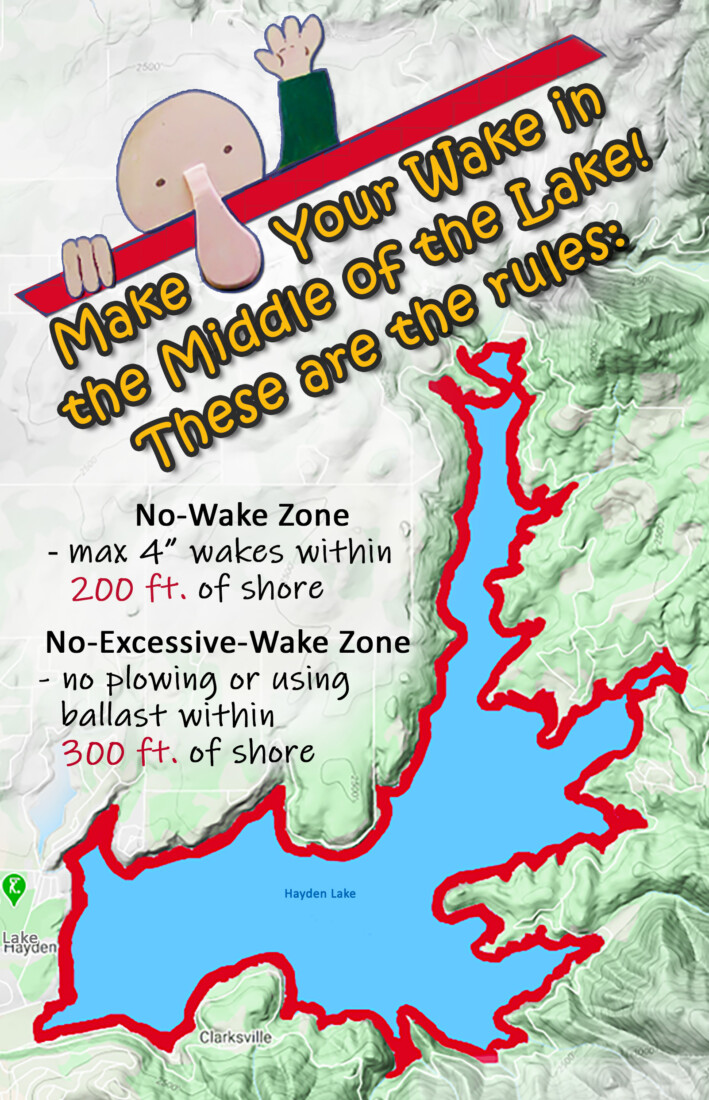 What about “300 feet?”– all permitted navigation buoys mark the 200-feet no-wake zone. The 300-feet reference pertains to the no-excessive-wake zone rule. Under this rule, boats cannot move in a way that creates excessive wakes within 300 feet of an encroachment. Such wake-inducing movement includes plowing, transitioning without moving to plane, and operating in wake-enhancing mode. Note that the vehicle’s speed is not the trigger for this rule, nor is wake height or type of boat. The energy of the wake produced is the key. Boaters are responsible for correctly estimating the 300-feet expanse. Their job is to reduce the force of their wake as they approach the no-excessive wake zone. The no-wake buoys offer reference points for this estimate as well.
No buoy, no wake limits, right? – If you don’t see a navigation buoy along a stretch of shoreline, does that mean you’re free to speed? No! The Kootenai County Ordinance 6-2-6 is still in effect. The 200-feet no-wake zone still exists. Boaters are responsible for correctly judging the distance with or without a buoy’s aid.
HLWID, IDL, and Kootenai County have worked hard to design the best buoy placement. The goal has been to weigh the good that buoys can do against their potential to disrupt safe navigation or the beautiful views from the water and the shore. Time and experience will tell whether the buoys are in suitable locations.
Thanks for all the good work. I think we are making progress, but we still have some folks misbehaving. I don’t know if it is miscommunication/different paradigms/or just plain irresponsibility. Some “misbehaviors” I have spoken with don’t seem to get it that no matter how far they are out, they should NOT create wakes that will be 4″ or more within 200′. They say “HEY” I am out at least 500′ so don’t bother me. BUT they don’t seem to understand they are responsible for the 1 1/2′ wake hitting shore that was initiated by their 3 1/2′ waking at 500′. Somehow “the middle of the lake” seems to translate to being very close to shore. Buoys help get folks out a bit, but if they generate big rollers, it makes NO Difference. :>( Byron
How long will it be before Hayden Lake boat traffic is managed like lakes in California where only so many boats are permitted and they have to move in rotational direction (clockwise) etc.. seems not too far off.
I talked tothe Sherriff & they said they had no input. When a stidy was done on Mokins Bay restrictions were recommended that the commissioners did not heed.
Why are you disregarding the Westexit from the Mokins back bay behind the sandbar that throws all the exiting boats to the West shoreline????
Wake up & take care of us too!!!
Rest assured, all of the stake-holding agencies mentioned including the Kootenai County Sheriff’s Office were a part of the consultation and collaboration resulting in the current configuration of buoys on Hayden Lake. Work such as this does not happen without it.