Eurasian watermilfoil is an invasive weed, first observed in Hayden Lake at Yellow Banks Creek in 1998, that has ringed the lake in recent years. Milfoil is the most-widespread, noxious, submerged weed in northern Idaho. Heavy growth can alter aquatic ecosystems, forming dense weed mats that shade-out other aquatic plants, degrade water quality, and impede beneficial use of the lake.
Do you already know all you need to know about the plant itself? Then jump to: What Can a Lake-Minded Person Do?
Get to Know Eurasian Watermilfoil (Myriophyllum Spicatum)
The first step toward managing milfoil is to identify it correctly. Casual observers frequently mistake native milfoils and other invasive plants for Eurasian watermilfoil.
How to Identify:
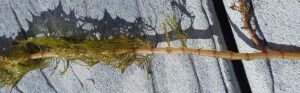
- Stems – are rooted to the lake-bottom; can be pink, white, tan, or red; typically grow 6-9 ft long, and branch aggressively to form a thick canopy at the water surface.
- Leaf-nodes – form along the stem; appearing at ½ to 4-inch intervals.
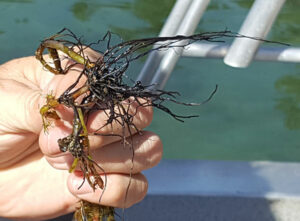
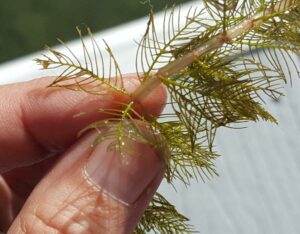
- Leaves – four leaves radiate from each node, evenly spaced in a whorl around the stem; each is feather-like with a central axis from which grow 12-14 or more pairs of thread-like leaflets. These float out from the stem in the water and fall limp when exposed to air.
- Flowers – small, yellow, 4-part flowers grow along a leafless spike that extends 2-4 inches above the water.
- Roots – spidery bundles, the root systems die back in the fall but can survive the winter and begin growing again in the spring.
These are NOT Eurasian Watermilfoil
- Northern Watermilfoil and Whorled Watermilfoil
- Native watermilfoil produces winter buds (dense clumps of dark leaves attached to the plant) in the late summer and fall; Eurasian watermilfoil does
- Native watermilfoils rarely branch near the surface.
- Northern watermilfoil has only 4-12 pairs of thread-like leaflets on each
- Leaves may remain erect from the plant when removed from the water.
- Whorled watermilfoil has small erect leaves between the flower clusters on its flowering spike, Eurasian watermilfoil does not.
- Coontail
- Leaves grow in whorls around the stem. Instead of having a central midrib on each, Coontail has filaments coming off the stem that split in half once or twice like mule deer
- Coontail is a free-floating plant without roots.
Where it grows:
Eurasian watermilfoil flourishes under a wide range of conditions.
- Grows in deep (up to 25 ft) or shallow water; preferring slow-moving locations.
- Produces well in water that is rich in nutrients.
- Grows best in fine-textured, organic soil such as sediment from runoff and erosion, and soil-buildup from decaying plants.
- Can tolerate a broader range of pH and salinity, higher temperatures, and more brackish water than native plants.
 Eurasian Watermilfoil’s Impact:
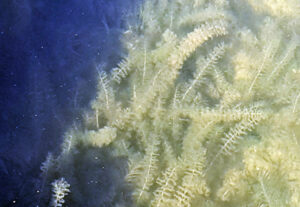 Eurasian Watermilfoil’s Impact:
- Dense milfoil growth at the surface makes enjoyment of the lake, i.e., boating, swimming, and fishing, difficult.
- It out-competes native plants for light and space. The ripple effects include reduced plant diversity, altered habitat for fish, and disrupted food chains for local inhabitants of the watershed.
- Dense plant growth can impede water flow, raise the water temperature, and cause stagnant water conditions.
- When the plant begins to die, surface mats drift or are blown onto the shore and require cleanup and proper disposal.
- As plants die, decomposition releases a large amount of phosphorus into the water.
- Algal blooms may follow decomposition along with depleted oxygen in the water and detrimental effects on fish.
What Can a Lake-Minded Person Do?
Vegetative fragmentation – the re-rooting of tiny pieces of plant – dominates the spread of milfoil. A single plant fragment can break off, settle in the sediment, grow roots, and establish a new plant. Wind, waves/wakes, and human activity produce weed fragments. These also spread weed fragments to other parts of the lake. After each flowering, the plant will grow roots at each node and auto-fragment.
Humans are the primary drivers of the spread of aquatic plants from one lake to another. They do this by transporting plant fragments attached to boats, trailers, fishing equipment, bait, and other gear.
Within a single lake system, any interaction with weeds, i.e., swimming, operating a boat motor, raking or stirring can liberate weed fragments. Wind- or wake-generated movement of the water will carry them to other, possibly un-infested areas around the lake. More aggressive or less cautious action will do more damage.
The Best Management is Prevention
When boating, fishing, or paddling:
- Clean, Drain, and Dry – Remove all plant fragments, even tiny ones. Drain water from bilges and inside the boat before leaving the access area. Allow all equipment to thoroughly dry before entering a new body of water.
- Rinse all equipment that touches the water – bait boxes, paddles, wading gear, coolers, etc.
- Avoid launching at ramps overrun with milfoil or curly-leaf pondweed. Weeds trapped between the bunks and the boat can be impossible to locate and remove.
Mechanical Control
Milfoil can be raked, pulled, or cut by hand or with a mechanical harvester, but at a considerable risk of affecting a short-term reprieve and an even greater long-term problem. Remember, a single fragment of the stem can take root, and cut stems can regrow and branch more aggressively than before. Take care to catch and remove all plant fragments when using these methods.
Hand-pulling is another mechanical control that is appropriate for smaller infestations of aquatic weeds. The entire plant must be removed or it will re-sprout. When care is taken to loosen rather than tear the roots from the sediment and to avoid releasing fragments, this can be a very effective and long-term solution. Professional weed-pullers can be hired who employ best-practices that minimize the spread of new weeds.
Whenever mechanically removing plant material from the lake, be sure to compost it far away from the water.
Chemical Control
Aquatic herbicides can offer another short-term solution for weed management. But chemical control of aquatic plants, including milfoil, must be undertaken only by entities with a National Pollutant Discharge Elimination System (NPDES) permit. There are professional applicators who hold an NPDES permit that allows them to treat aquatic weeds in north Idaho.
The Idaho State Department of Agriculture (ISDA) is very active in the effort to manage noxious and invasive plant species. They continue to invest heavily in the well-being of Hayden Lake by implementing chemical and mechanical weed control throughout. If hiring an NPDES-permitted applicator to chemically-control weeds along your shoreline, please ensure that the contractor collaborates with ISDA so that the waters of Hayden Lake are not over-dosed with herbicide chemicals.
Take it Out of the Watershed!
When you do pull the weeds up and out of the water, remember that decaying plants release phosphorus and nitrogen – nutrients that we would like to get out of the lake! Phosphorus contributes to blue-green algal blooms, other plant growth, and the general deterioration of the lake. So instead of leaving dry weeds on the banks or slope of your property where viable fragments or nutrients could wash back into the lake, find a beneficial place to dispose of them. If need be, take them out of the watershed!
Information at Your Fingertips
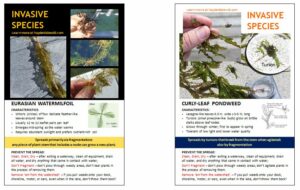
Keep information handy about the two most prominent aquatic invasive plants in Hayden Lake. Print and post these Invasive Species Cards: