Idaho is legendary for its pristine waters, dramatic wilderness, healthy fisheries, and abundant opportunities to enjoy the outdoors. Hayden Lake, in particular, is known for its crystal-clear water and family-friendly lifestyle. Fishing, cruising, swimming, paddleboarding, and water sports are part of the legacy we all share.
One of the greatest threats to Hayden Lake and Idaho’s waterways is the introduction of invasive mussels, including quagga mussels, zebra mussels, and the more recently discovered golden mussel.
Quagga mussels have already been detected in Idaho, and the stakes are enormous. Invasive mussels are incredibly expensive to control and nearly impossible to eliminate.
The State of Idaho has already allocated several million dollars to manage the Snake River infestation first discovered in 2023, with treatments conducted during each of the past three years. Any successful eradication effort requires a long-term strategy with ongoing monitoring. If invasive mussels become widespread throughout Idaho, the financial impact is estimated to reach hundreds of millions of dollars in direct and indirect costs.

What Are Invasive Mussels?
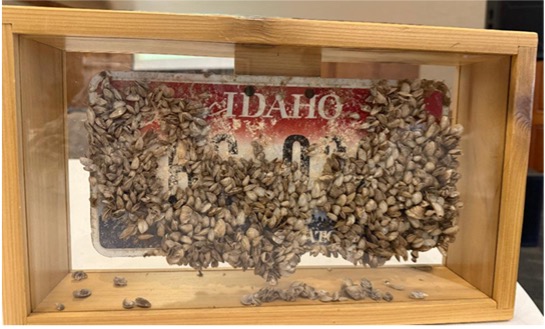
Quagga, zebra, and golden mussels are all bivalves, meaning they have two shells (or valves). Their shells sometimes display striped patterns, giving zebra mussels their name, but they can also appear solid brown, tan, or golden.
These mussels attach firmly to almost any hard surface, including:
- Boats
- Pumps
- Valves
- Intake screens
- Piers
- Rocks
- Native mussels
They anchor themselves using strong, root-like protein fibers called byssal threads.
Adult mussels grow up to about two inches long, while their larvae are microscopic and nearly impossible to detect. They typically live four to five years and often form dense colonies.
Native to Eurasia, invasive mussels have few natural predators in North America. As a result, they multiply rapidly and can completely carpet underwater surfaces.
The golden mussel, recently detected in California’s San Joaquin Valley, is sometimes described as “a zebra mussel on steroids” because it can survive in cooler water temperatures and lower calcium levels.

Impacts to Idaho’s Water Infrastructure
Invasive mussels threaten Idaho’s water delivery systems by clogging irrigation infrastructure and restricting water flow.
Hydropower facilities also face increased maintenance costs because mussels clog:
- Pipes
- Pumps
- Turbines
- Filtration systems
These added costs are often passed on to consumers through higher utility bills. Farmers also experience increased operating costs, which can ultimately contribute to higher grocery prices.

Impacts to Boats and Watercraft
Invasive mussels can cause significant damage to recreational boats and other watercraft.
They may block engine cooling systems, causing engines to overheat, and can interfere with steering equipment, creating serious safety risks.
Once attached, mussels require constant scraping and cleaning, which can eventually damage boat finishes and require repainting.
They also colonize nearly every submerged surface, including:
- Boat ramps
- Docks
- Mooring lines
- Bumpers
- Swim steps
- Boat lifts
Keeping these surfaces clean becomes an ongoing and costly maintenance challenge.

Impacts to Idaho’s Natural Spaces
Invasive mussels dramatically alter aquatic ecosystems.
Because they are filter feeders, they remove enormous amounts of plankton from the water, reducing the food available for native fish and wildlife. This disruption affects the entire food chain.
The effects can be devastating. In Lake Ontario, lake trout populations declined by approximately 95 percent over the past decade following ecosystem changes caused by invasive mussels.
Mussel infestations may also contribute to increased harmful algae blooms.
Dense carpets of sharp shells can extend from the shoreline into the water, making beaches hazardous. Children, pets, and swimmers are at risk of painful cuts from the razor-sharp shells.
As mussels die and decompose, they create unpleasant odors often compared to rotten fish and sewage. Beaches become less inviting, tourism declines, and waterfront property values can suffer.
The Good News
Although the threat is real, there is encouraging news.
- Invasive mussels are not currently established in North Idaho waters, including Hayden Lake. However, the risk of introduction remains significant.
- The primary way invasive mussels spread is through people moving watercraft from one body of water to another. Mussels and their microscopic larvae can survive in water trapped inside boat engines, ballast tanks, bilges, live wells, buckets, and other equipment.
Because this is a human-caused pathway, it is also preventable. Every boater can help protect Hayden Lake by following the simple practice to Clean, Drain, and Dry their boat and equipment before entering another waterbody.